Are Paper Cups Safe for Hot Drinks? Safety Guide (2026)
Over 250 billion disposable cups enter circulation every year—most filled above 65 °C. At those temperatures, the liner inside the cup, not the paper, determines whether chemicals migrate into your drink.
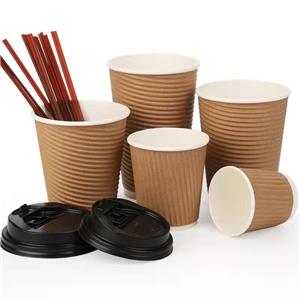
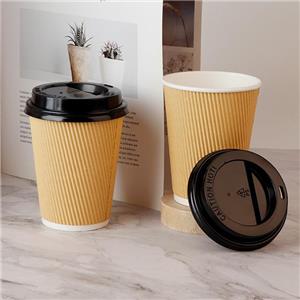
Paper cups with food-grade linings are safe for hot drinks when used within their rated temperature range. But PE, PLA, and water-based barrier coatings behave very differently under heat. This guide covers the real differences, what the FDA and EU require, and what to check before you sign a purchase order.
I'm writing from the production side. Our Wuhan factory produces over 15 million paper cups per month across all three liner types, and I've spent the past decade reviewing migration test reports and answering buyer questions about safety claims. —Iris Lei, Xinyujie
In This Article
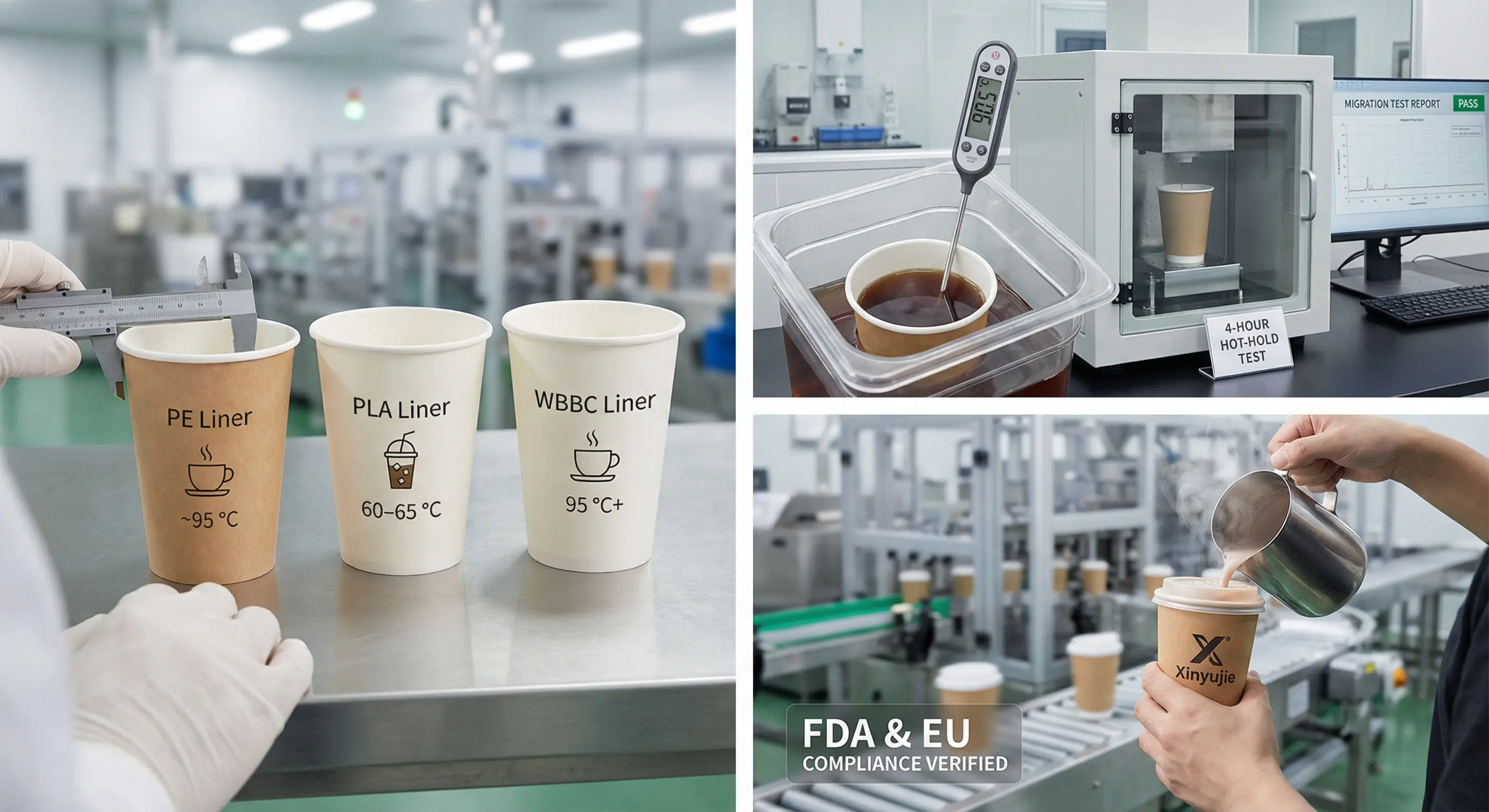
Three Liner Types Compared: PE vs. PLA vs. Water-Based Barrier
The paper itself is relatively inert—150–350 gsm virgin kraft. Safety hinges on the barrier layer bonded to the inside. Three technologies dominate the market:
| Feature | PE (Polyethylene) | PLA (Polylactic Acid) | WBBC (Water-Based) |
|---|---|---|---|
| Source | Petroleum | Corn starch | Aqueous coating |
| Max temp | ~95 °C | 60–65 °C | 95 °C+ |
| Compostable | No | Industrial only | Yes* |
| Microplastic risk | Higher | Lower | Lowest—no plastic film |
| Cost / 1,000 (12 oz) | $28–38 | $40–55 | $45–60 |
| Recyclable | Difficult | Difficult | Repulpable |
*Formulation-dependent. FOB China pricing, 2025–2026, orders ≥100K pcs.
PLA's Temperature Problem
PLA (polylactic acid) is a bioplastic derived from fermented corn starch with a glass transition around 55–60 °C. Pour 90 °C coffee in, and the liner softens—causing deformation, leaking, even structural collapse.
I've had buyers specify PLA for hot cups without knowing this. It creates real problems when their café customers report collapsing cups. We steer those orders to PE or WBBC and recommend PLA strictly for cold beverages—iced coffee, smoothies, cold brew.
Why We Tested Six WBBC Formulas
Water-based barrier coatings (WBBC) skip plastic entirely. An aqueous dispersion forms the moisture barrier—no PE, no PLA, no microplastic shedding.
Here's the catch: quality varies wildly. We tested six chemistries over two years before finding two that consistently passed our 4-hour hot-hold test without bleed-through. WBBC cups cost roughly 20–35% more per unit than PE at comparable volumes—but for buyers whose customers care about microplastics, the premium pays for itself.
Chemical Migration & Microplastics
Chemical migration is the transfer of substances from packaging into food or beverages. It's the core metric behind FDA 21 CFR and EU Regulation (EC) No. 1935/2004.
Key substances screened: phthalates, PFAS, VOCs, and overall migration (EU cap: 10 mg/dm²). BPA comes up often, but modern PE and PLA resins don't contain it. That concern applies to older polycarbonate plastics—different materials entirely.
Temperature matters. A 2024 Indian Institute of Technology study measured 3× higher total organic migration from PE cups at 85 °C versus 25 °C—still within regulatory limits, but a measurable gap. This is why a cup's rated temperature isn't a marketing detail. It's a safety boundary.
Do Paper Cups Leach Microplastics into Hot Drinks?
Research from the U.S. National Institute of Standards and Technology (NIST, 2020) found PE-lined cups release trillions of nanoplastics in hot water. A 2021 IIT study reported roughly 25,000 micron-sized particles per cup after 15 minutes at 85 °C.
The WHO's 2022 assessment called microplastics in drinking water "low concern" but flagged the need for more data. The EU's PPWR, phasing in through 2026–2030, explicitly targets microplastic contamination from food-contact materials.
Survey data from the Food Packaging Forum (2025) shows 67% of U.S. consumers now factor microplastics into packaging choices. WBBC cups sidestep this concern entirely—there's no plastic film to fragment.
FDA & EU Food-Contact Compliance
The FDA regulates food-contact paper under 21 CFR 176.170 (paperboard) and 21 CFR 177.1520 (PE resins). One critical distinction: "FDA compliant" means materials meet extraction limits under intended conditions. It does not mean the FDA inspected each cup. Ask for the migration test report, not just a declaration.
The EU framework—Regulation (EC) No. 1935/2004 plus (EU) No. 10/2011 for plastic layers—sets individual substance migration limits and the 10 mg/dm² overall cap. PPWR (2026–2030) adds recyclability and composition targets for all packaging.
Every cup leaving our factory ships with a destination-matched compliance declaration. U.S. orders get an FDA certificate with SGS migration data. EU orders get a Declaration of Compliance per (EC) 1935/2004. These exist for every SKU in production—not generated on request.
Are Compostable Cups Safer Than Conventional Ones?
Not automatically. "Compostable" describes end-of-life behavior, not in-use safety. A compostable cup can still contain substances that migrate into hot beverages.
That said, compostable cups tend to perform better on two fronts: lower microplastic risk (especially WBBC) and fewer legacy chemicals—because substances like PFAS interfere with composting certifications.
To earn BPI certification (U.S.) or OK Compost (EU, TÜV Austria), products must pass biodegradation, ecotoxicity, heavy metals, and PFAS screening (below 100 ppm total fluorine, mandatory since 2023). Over 680 product families held active BPI certification as of late 2025.
If you're distributing compostable cups in California, Washington, Colorado, or Vermont—BPI certification is functionally required for market access. "Compostable" without a certificate number is a marketing claim. Certified compostable is a verifiable standard. Big difference.
Buyer Verification Checklist
Here's what I recommend verifying before you place a paper cup order—built from issues I've seen trip up importers over the years:
✅ Supplier Verification: Paper Cup Safety & Compliance
Migration test report — actual lab data from SGS, Bureau Veritas, or Intertek showing test conditions and quantified results. Not just a certificate.
Rated temperature — ask explicitly: "What's the max serving temperature for this cup?" Vague answers are a red flag.
Liner material & thickness — PE, PLA, or WBBC? What specific resin or coating?
Compostability certificate number — searchable in the public BPI or TÜV database. No number = unverified claim.
PFAS status — "Does this product contain intentionally added PFAS?" At least 14 U.S. states restrict PFAS in food packaging as of early 2026.
Hot-liquid sample test — fill at your serving temperature, hold 30 minutes, check for softening, bleed-through, or off-odors. Simple, but I'm always surprised how many buyers skip this step.
We ship free evaluation samples with a complete technical package—cups, lids, migration reports, material declarations, compostability certificates—before any production order. Don't finalize specs from a photo and a price. Test with real liquid at real temperatures.
Frequently Asked Questions
Do all paper cups contain plastic?
Most conventional cups use a polyethylene (PE) liner—a thin plastic film. Plastic-free alternatives include water-based barrier coated (WBBC) cups, which contain no plastic at all. PLA cups use a plant-based bioplastic—biologically derived, but still technically a plastic.
What temperature is too hot for a paper cup?
PE handles ~95 °C. PLA softens above 60–65 °C—unsuitable for fresh-brewed coffee. WBBC performs at 95 °C and above. Always confirm rated temperatures with your supplier.
Are compostable drinking cups safe for hot coffee?
Yes—if rated for hot service. A WBBC or double-wall compostable cup at 90 °C+ works fine. A PLA-lined cup designed for cold drinks will deform. Check the spec sheet, not just the "compostable" label.
How do I verify a paper cup is FDA compliant?
Request the migration test report—not just a certificate. It should reference 21 CFR 176.170 for paperboard and 21 CFR 177.1520 for PE, with quantified results from an accredited lab like SGS or Intertek.
Are paper cups better than Styrofoam for hot drinks?
Yes. Expanded polystyrene (EPS) can release styrene—classified as a probable carcinogen by IARC. EPS is banned or restricted in over 130 U.S. municipalities as of 2026. Paper cups with food-grade liners don't carry that risk.
Can I put my brand logo on compostable paper cups?
Yes. At Xinyujie, we use water-based and soy-based inks that maintain compostability and food-contact safety. Minimum order for custom print is typically 50,000 pieces with Pantone color matching.
Making the Right Call
Paper cups are safe for hot drinks—when the liner is rated for the serving temperature, manufactured with food-grade materials, and backed by third-party migration testing.
PE-lined cups — most affordable for hot beverages, but higher microplastic concerns and not compostable
PLA-lined cups — compostable with lower migration risk, but can't handle beverages above 65 °C
WBBC cups — cleanest safety profile with no plastic and high heat tolerance, at a 20–35% cost premium
We manufacture all three liner types at our Wuhan facility. If you're evaluating options, we'll send samples with full technical documentation so you can test against your specific use case.
Need Samples Before You Commit?
We send cups, lids, migration reports, and compostability certificates—free, before any production order.
Request SamplesBrowse Cup LinesIris Lei
Export Manager at Xinyujie — a paper and compostable packaging manufacturer in Wuhan, China, supplying distributors across 35+ countries since 2014.