In the US market, which paper coffee cup specifications are most popular with end customers?
Entering the US market can be confusing. The sizes are bigger, and the preferences are very specific. I have helped many clients optimize their specs to match what Americans actually buy. You do not want to ship a container of cups that nobody wants to hold.
In the US market, the most popular specifications are the 12oz, 16oz, and 20oz sizes with a standard 90mm rim diameter. End customers strongly prefer double-wall cups with a matte Kraft finish over single-wall cups with sleeves. For lids, ergonomic "dome" styles are favored, and BPI certification is essential in coastal urban areas.
Knowing the general trends is good, but the devil is in the details. A millimeter difference in the rim or the wrong bottom width can ruin your sales. Let's break down exactly what you need to order.
What are the standard paper cup sizes preferred by American coffee drinkers?
In Europe or China, a small cup is common. In the US, "bigger is better." I often warn my clients that if they only stock small sizes, they will lose the morning commuter crowd. You need to understand the "Grande" culture.
American coffee drinkers prefer the 12oz, 16oz, and 20oz sizes, with the 16oz "Grande" often being the top seller for morning commutes. The market demands a standardized 90mm rim across these sizes to simplify lid inventory. Additionally, the cup's bottom taper must fit standard 2.5 to 3-inch vehicle cup holders.
When you look at the US market, volume is king. The "Holy Trinity" of sizes is 12oz, 16oz, and 20oz. While 8oz cups exist, they are mostly for specific espresso drinks like Flat Whites. For the average American driving to work, 16oz is the standard. It holds enough caffeine to start the day. If you look at the sales data from major chains, the 16oz often outsells the 12oz. This is very different from the European market, where 8oz and 10oz are common.
The Importance of Rim Standardization
As a factory owner, I see a huge operational advantage in the US preference for the 90mm rim. In the past, 10oz or 12oz cups might have had an 80mm rim. This is a headache for shop owners. They have to buy two different sizes of lids. This wastes storage space and confuses the staff during a rush.
Today, the smart specification is to have your 12oz, 16oz, and 20oz cups all share the same 90mm rim diameter. This allows you to use one universal lid. It simplifies your supply chain. When you order from us, we ensure the tooling matches perfectly across all three volumes.
The "Tall and Slim" Perception
Another interesting psychological trick is the shape. You can make a 12oz cup that is short and wide ("squat") or tall and thin. The US market strongly favors the "tall and slim" profile. Why? because it looks like good value for money. A tall cup looks bigger to the customer, even if the liquid volume is the same.
The "Drive-Thru" Test
There is one physical constraint you cannot ignore: the car cup holder. Americans drive everywhere. Standard US vehicle cup holders are about 2.5 to 3 inches wide at the base. If your cup has a wide bottom that does not taper enough, it will not fit. Customers will spill coffee in their new cars. They will never return to that coffee shop. We strictly control the bottom diameter of our molds to ensure they pass this "Drive-Thru Test."
| Cup Size | Rim Diameter | Market Role | Key Requirement |
|---|---|---|---|
| 12oz (Tall) | 90mm | Standard Regular | Must look substantial, not small. |
| 16oz (Grande) | 90mm | Best Seller (Commuter) | Must fit car cup holders perfectly. |
| 20oz (Venti) | 90mm | Iced / Long Drive | Needs high rigidity to prevent collapse. |
Do US consumers prefer ripple wall or double wall cups for hot beverages?
I still see many buyers asking for single-wall cups to save money. But when I visit coffee shops in Chicago or New York, I see a different story. Customers hate burning their hands, and they hate fiddling with cardboard sleeves.
US consumers overwhelmingly prefer double-wall cups over single-wall cups because they eliminate the need for a separate cardboard sleeve, which is seen as cumbersome waste. Specifically, the "Matte" finish on Kraft paper is trending because it signals premium quality and organic values, whereas high-gloss finishes are associated with cheap fast food.
In the US, convenience is everything. The old way of serving coffee was a thin Single Wall cup plus a cardboard sleeve (often called a "java jacket"). This is clumsy. The sleeve often slides off. It adds an extra step for the barista. It creates two pieces of trash instead of one.
The Double Wall cup solves all these problems. It has a built-in air pocket that keeps the coffee hot and the hands cool. It feels solid and expensive. Even though the unit price is higher than a single wall cup, you save money by not buying sleeves. You also speed up service. For the end customer, it just feels like a better product.
The Rise of "Kraft" and Matte Finishes
Aesthetics drive sales. Right now, the "Unbleached Kraft" look is dominating the US specialty coffee scene. Brown paper looks natural. It signals "organic" and "eco-friendly" to the consumer immediately.
Here is a secret: sometimes the inner lining is exactly the same as a white cup. But the perception of the brown paper is powerful. It makes the customer feel good about their purchase.
Texture matters too. We offer both Glossy and Matte finishes. In the US, Glossy cups are often associated with gas stations or fast-food chains. They feel slippery. Matte finishes feel like artisanal paper. They have a "dry" grip that feels secure in the hand. For a premium brand, I almost always recommend a Matte finish. It elevates the perceived value of the coffee inside.
The Ripple Wall Niche
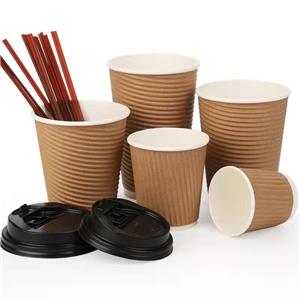
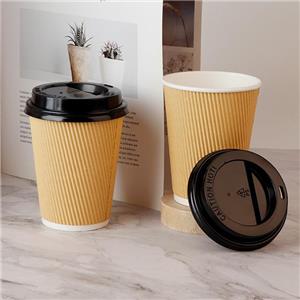
Ripple Wall cups are also popular, especially on the East Coast. They offer the best heat protection. The texture is very grippy. However, they do not print as well as smooth Double Wall cups because of the uneven surface. If your logo is complex, go with Double Wall. If you want maximum heat safety and a unique tactile feel, go with Ripple Wall.
| Wall Type | Consumer Perception | Best Application |
|---|---|---|
| Single Wall + Sleeve | Standard, Cluttered | Low-cost, High-volume events. |
| Double Wall (Matte) | Premium, Modern, Clean | Specialty Coffee Shops, Branding focus. |
| Ripple Wall | Safe, Rugged, Grippy | Very hot teas, Winter drinks. |
| Kraft Finish | Organic, Eco-conscious | Brands focusing on sustainability. |
How important is BPI certification for paper cups in the current US market?
This is where the US market is split. What works in Texas might get you fined in San Francisco. I help clients navigate these complex compliance maps so they do not get stuck with illegal inventory.
BPI certification is critical in US coastal urban centers like Seattle, San Francisco, and New York, where strictly enforced composting mandates ban standard plastic linings. However, in the Midwest and South, standard PE-lined cups remain the volume leader due to lower cost and a lack of industrial composting infrastructure.
The United States is huge. It is not one single market. It is really two markets combined.
Market A: The Eco-Conscious Coast. In cities like Seattle, San Francisco, Los Angeles, and New York, regulations are very strict. Many of these cities have banned single-use plastics or require packaging to be commercially compostable. In these areas, if your cup is not BPI certified (Biodegradable Products Institute), you cannot sell it. You need a cup lined with PLA (corn starch) or an aqueous coating. Distributors here will check your paperwork. They will ask for the BPI certificate number. If you don't have it, you are out.
Market B: The Heartland. In the Midwest and South, the focus is often on price and performance. Industrial composting facilities are rare. In these regions, a standard PE-lined cup is still the king. It is cheaper and holds up better to extremely hot liquids.
Lid Trends: The Move to Domes
Regardless of the lining, the lid design is universal. The old "flat lids" are disappearing. US consumers prefer "Dome Lids" or "Traveler Lids" with an elevated spout.
There are two reasons for this. First, Americans love toppings. Whipped cream, caramel drizzle, and foam need space. A flat lid squashes the drink. Second, ergonomics. A traveler lid has a raised sipping hole. This accommodates the nose. It is more comfortable to drink from while walking or driving. It reduces the "nose collision" that happens with flat lids.
The Critical "Rolled Rim" Quality
Finally, we must talk about the rim tightness. This is a major quality indicator for US buyers. Americans often carry their cups by the rim, especially when juggling keys and a phone. The rolled rim must be incredibly stiff.
If the rim is loose, it will flex when squeezed. This causes the lid to pop off. A coffee spill lawsuit in the US is no joke. At our factory, we use high-speed forming machines that compress the paper tightly. We test the "rim stiffness" to ensure it can support the full weight of a 20oz drink without bending. This is a non-negotiable spec for the US market.
| Feature | Specification | Why it Matters in US |
|---|---|---|
| Eco-Lining | PLA (BPI Certified) | Mandatory in CA, NY, WA. |
| Standard Lining | PE (Polyethylene) | Standard in Midwest/South; Lower cost. |
| Lid Style | Elevated Dome / Traveler | Fits whipped cream; Better ergonomics. |
| Rim Quality | High Compression Stiffness | Prevents spills; Supports carrying weight. |
Conclusion
To succeed in the US, prioritize 16oz and 20oz sizes with 90mm rims, choose double-wall matte Kraft for premium appeal, and ensure BPI certification for coastal markets. Quality rims and ergonomic lids are essential for safety.