Complete guide to disposable paper food containers: clamshell vs two-piece designs, grease resistance, microwave safety, lids, and supplier checks.
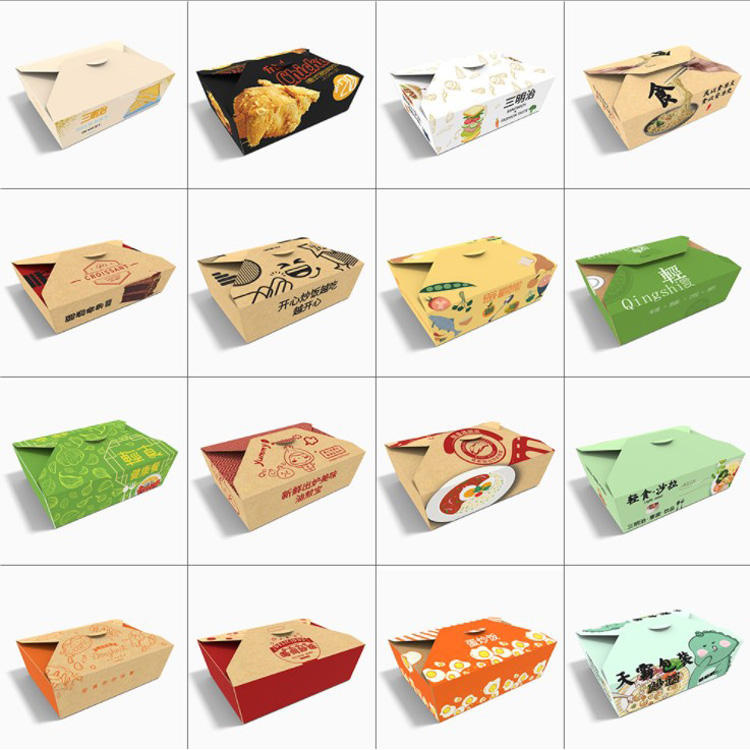
Disposable Paper Food Containers: The Complete Buyer's Guide for 2026
Of all the packaging a restaurant buys, disposable paper food containers carry the most risk. They hold the heaviest food, sit through the longest delivery times, and get reheated in a customer's microwave before the first bite. A leaking cup is annoying; a collapsing lunch box that sauces someone's backpack is a one-star review. This guide covers the decisions that matter: container designs, grease resistance, microwave behavior, lids, certifications, and how to test samples before you commit to volume.
What Counts as a Paper Food Container
The category covers three distinct product families, and mixing them up is the most common ordering mistake:
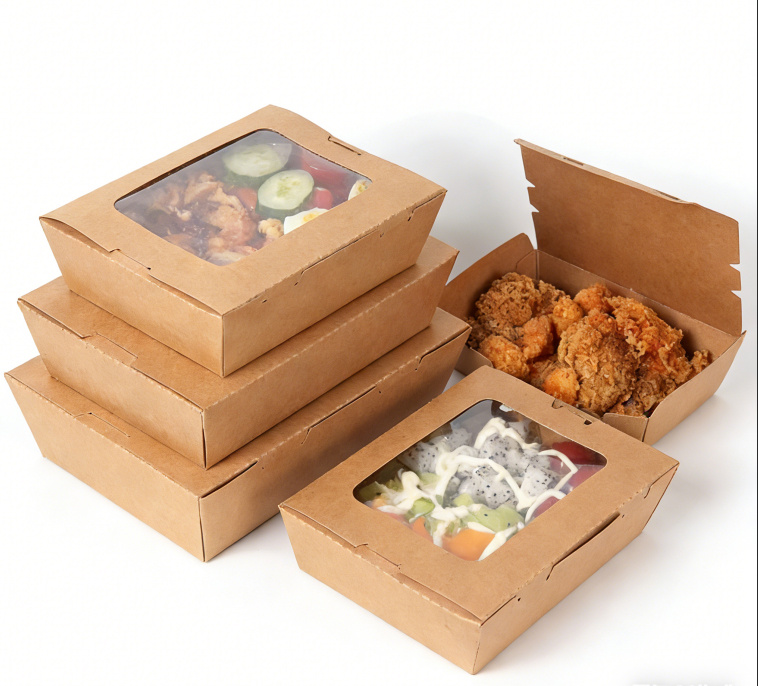
Clamshell containers — one-piece hinged boxes (burger boxes, sandwich boxes); fastest to pack, no separate lid to stock
Two-piece base-and-lid boxes — rectangular or square bases with separate lids; the standard for noodles, rice dishes, and meal-prep
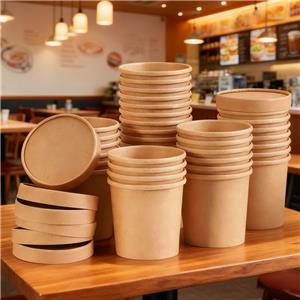
Bucket-style / round paper bowls with sealing lids — technically bowls, but sold in the same category for soup and sauced dishes
Each family has different lid logic, leak behavior, and cost per unit. Order them as separate SKUs with separate specs — never as one generic "food container" line item.
Clamshell vs Two-Piece: Choosing the Right Design
Clamshell (Hinged) Containers
Best for dry or semi-dry food: burgers, sandwiches, wraps, pastries, fried items.
Advantages:
One-handed packing — critical at rush hour
No lid inventory to manage
Doubles as a serving plate for dine-in
Weaknesses:
Hinge is a stress point; cheap versions crack after 2–3 open/close cycles
Poor seal for liquid-heavy food — a saucy dish in a clamshell will leak in a delivery bag
Two-Piece Containers
Best for wet, heavy, or sauced food: rice plates, pasta, curries, salads with dressing.
Advantages:
Lid options are far broader (paper, PP, PET, bagasse)
Snap-on or locking lids seal far better than any hinge
Stackable and nest-able for storage
Weaknesses:
Two SKUs to stock and match
Slightly slower to pack; mis-matched lids from different suppliers cause leaks
Rule of thumb: dry food → clamshell; anything with sauce that can pour → two-piece with a locking lid.
Sizes and Compartments: Matching the Box to the Menu
Paper food containers are usually specified by dimensions plus fluid capacity. Common ranges:
Container | Typical Size | Common Use |
Small clamshell | 5.5"–6" | Burgers, sandwiches, pastries |
Large clamshell | 8" | Double burgers, hot dogs, large wraps |
500–750 ml base | Rectangular | Small rice/noodle portions, sides |
1000–1200 ml base | Rectangular | Standard takeout entrée, meal-prep |
1500–1800 ml base | Rectangular | Family portions, large salads |
Multi-compartment (3–4) | 1000–1500 ml | Bento-style meals, school and corporate catering |
Compartment boxes deserve special attention: they exist to keep sauces away from dry components, but only work if the dividers are high enough and the lid sits above them. Ask for cross-section samples — divider height is the spec suppliers most often quietly reduce to save cost.
The Grease Problem: Why Lining Type Decides Everything
Like paper bowls and bags, a paper container is only as good as its barrier. Three lining families dominate:
1. PE-Lined Containers
Polyethylene coating gives full waterproof and greaseproof performance at the lowest cost. Reliable for hot, oily dishes. Trade-off: not recyclable in standard paper streams, and increasingly restricted in some markets.
2. PLA-Lined / Compostable Containers
Plant-based bioplastic lining certified compostable under EN 13432 or ASTM D6400. Handles hot food well but softens above ~60°C — fine for holding hot food, not for microwave reheating.
3. Water-Based Barrier Coating (Plastic-Free)
The newest and fastest-growing option: no plastic lining, recyclable in standard paper streams, grease-resistant, and microwave-safe. It carries a price premium, but for brands selling into the EU or plastic-restricting US states, it is rapidly becoming the default spec.
Whatever lining you choose, demand a written grease-resistance spec (commonly expressed as a Kit Test rating, e.g. Kit 8–12 for fried food). "Greaseproof" without a number is a marketing word, not a specification.
Microwave Safety: The Reheating Reality
Your container will go into a customer's microwave. That's not a nice-to-have — it's how takeout food is actually eaten. The rules:
PE-lined — microwave-safe for short reheats (1–2 minutes); lid must come off if it's PP with a steam valve closed, or PET (PET deforms with heat)
PLA-lined — do not microwave; PLA softens around 60°C and the container will warp
Water-based coated — the most microwave-friendly option, typically 2–3 minutes
Never any paper container in a conventional oven or on a direct-heat surface
Print the microwave guidance on the container itself or the lid — it prevents the most common customer misuse, and it signals a brand that understands how its packaging is used.
Lids and Sealing: Where Leaks Actually Happen
In delivery testing across the industry, the container wall almost never leaks — the lid interface does. Before bulk ordering:
Match lid to base from the same supplier — "compatible" lids from different factories are the top cause of leaks
Test with real food — fill with actual hot, oily sauce at 85–90°C, seal, invert for 10 minutes, then shake; water tests hide failures
Consider locking-lid designs for delivery-heavy menus — a snap-on lid that clicks on all four sides survives transport far better than a loose-fit lid
Check venting — trapped steam softens paper lids and pops snap-lids open; some lids include a peel-off vent tab
Stack test — fill, seal, and stack four containers; the bottom one must not deform or pop its seal
Eco Certifications: What to Verify
FSC® or PEFC — responsibly sourced fiber; verifiable by license number
EN 13432 (EU) / ASTM D6400 (US) — industrial compostability for PLA-lined and bagasse products
BPI Certified — the recognized compostability mark in North America
PFAS-free declaration — critical, since grease-resistant treatments were historically a hidden PFAS source; EU food-contact law is tightening on this
FDA / LFGB food-contact compliance — mandatory for direct food contact in the US and EU respectively
One honesty note for your own marketing: "compostable" means industrial facilities only. If your customers' city lacks them, a recyclable water-based coated container is often the greener real-world outcome — and explaining that nuance builds more trust than a generic leaf logo.
How to Vet a Paper Food Container Supplier
Sample with real menu items — pack your actual hottest, sauciest dish and run a full delivery-length transit test
Written specs — paper GSM, lining type, Kit grease rating, capacity, and lid material documented per SKU
Verifiable certificates — check FSC license codes and compostability certificate numbers in the issuing databases
Dimensional consistency — containers must stack and seal consistently across production runs; ask about tolerance
Microwave test data — request the supplier's reheating test results, not just their claim
Transparent pricing structure — confirm what's included (inspection, freight, paperwork) before comparing quotes
Importing from manufacturers in China, Vietnam, or India cuts unit costs 30–50% at container volumes, but food containers demand stricter incoming inspection than cups or bags — a failed container leaks food, not just liquid. Smaller operations should start with a regional distributor, then move to direct import once monthly volume justifies it.
Frequently Asked Questions
Are paper food containers microwave safe?
PE-lined and water-based coated paper containers are microwave-safe for 1–2 minute reheats. PLA-lined containers are not — PLA softens around 60°C. PET lids must be removed before microwaving; PP lids can stay on if vented.
Can paper containers hold saucy food without leaking?
Yes, if the lining is intact and the lid seals properly. In practice, almost all leaks come from mis-matched or loose lids, not the container wall. Buy base and lid from the same supplier and test with real hot sauce before bulk ordering.
What is the best container size for meal prep?
1000–1200 ml rectangular bases are the meal-prep standard for single portions; 1500 ml suits larger appetites. Three-compartment 1200 ml boxes work best when sauces need separating from grains.
Are compostable paper containers really compostable?
Only in industrial composting facilities, which is what EN 13432 and ASTM D6400 certify. In a landfill or backyard bin, they break down no faster than conventional containers.
How much do disposable paper food containers cost?
At wholesale volume, clamshells run 0.05–0.12 each, two-piece bases with lids 0.10–0.25, and multi-compartment boxes 0.15–0.35, depending on size, lining, and print. A restaurant doing 300 takeout orders daily spends roughly 1,500–3,000 per month on containers — which is why sealing failures are worth engineering out.
Final Takeaway
Choosing disposable paper food containers comes down to five decisions: the right design (clamshell vs two-piece) for how wet your food is, a lining with a written grease rating, microwave behavior that matches how customers actually eat, a lid system tested with real hot food in real transit, and verifiable certifications for your market. A container that survives the delivery bag and the microwave without incident is invisible — and invisible is exactly what packaging should be.
Looking for wholesale disposable paper food containers with custom printing? [Contact our team / Browse our catalog] for samples and factory-direct pricing.